GEO vs SEO vs AEO: What's the Difference in 2026?
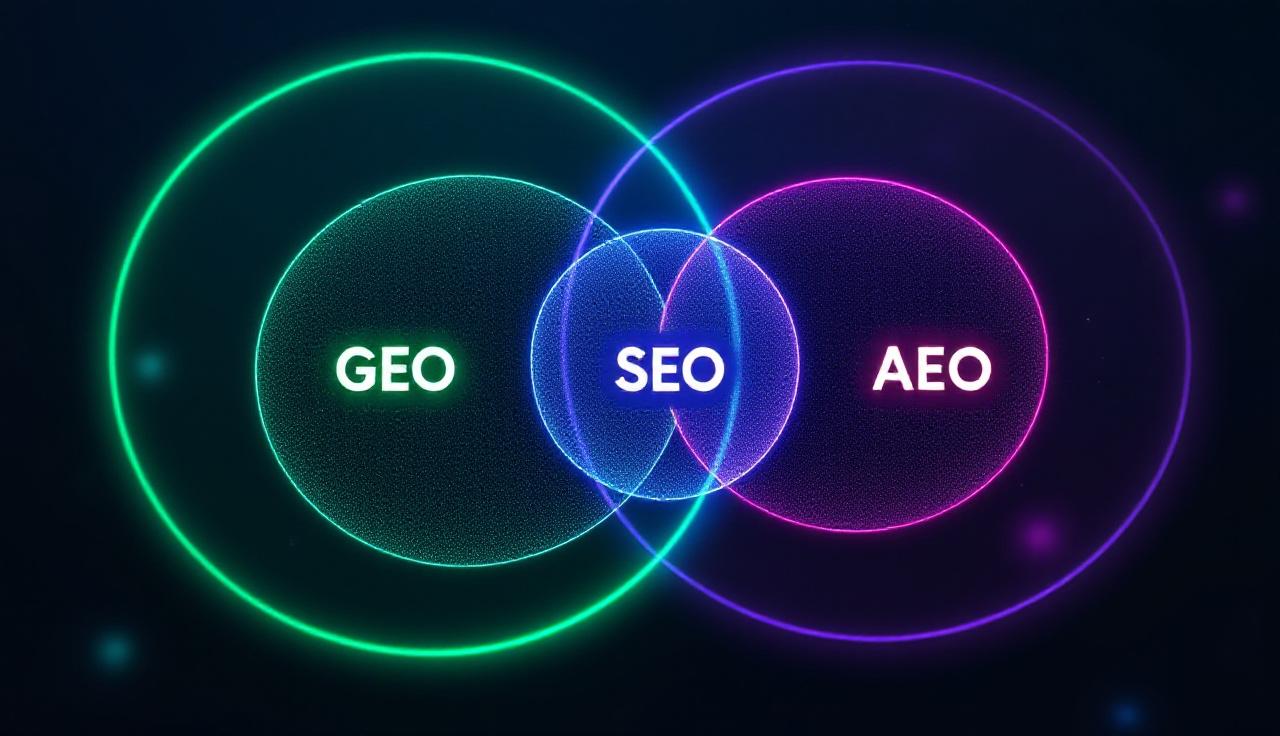
Three acronyms, three different search paradigms. SEO was built for Google's link-graph world. AEO was a transitional term for voice/featured-snippet optimization. GEO is where 2026 attention is focused: getting cited by AI engines that generate answers rather than list links. Here's exactly how they differ and which to prioritize.
SEO — what it is and where it still matters
SEO remains the dominant strategy for capturing Google traffic, which represents the majority of web search volume in 2026. The core mechanics — backlinks, domain authority, keyword relevance, Core Web Vitals — are well-established and unlikely to disappear.
Where SEO falls short in 2026 is that it optimizes for a ranking position, not for content extraction. A #3 result on Google may never appear in a ChatGPT answer if it isn't structured for AI extraction — even if it's technically crawlable by all the right bots.
AEO — where the term came from
AEO emerged around 2018–2020 as voice search (Alexa, Siri, Google Assistant) pushed marketers toward question-answer formatted content and featured snippet optimization. The idea was that if you could get your content into the "position zero" featured snippet on Google, you'd also be the source voice assistants cited.
AEO tactics — FAQPage schema, direct Q&A structure, concise answers — are now core GEO tactics. The term AEO has largely been absorbed into GEO, which is broader and more precise.
GEO — why it's the priority for 2026
GEO targets a fundamentally different output than SEO. You're not trying to appear in a list of 10 blue links. You're trying to be the source an AI engine cites when it generates a single synthesized answer.
This changes the optimization logic entirely:
| Dimension | SEO | GEO |
|---|---|---|
| Goal | Rank #1–10 in SERPs | Get cited in AI-generated answers |
| Primary signal | Backlinks + PageRank | Structured data + content clarity + freshness |
| Index target | Google (primarily) | Bing (ChatGPT), Brave (Claude), Perplexity own index |
| Content format | Long-form, keyword-dense | Answer-led, concise, fact-dense |
| Technical focus | robots.txt, sitemaps, Core Web Vitals | robots.txt (35+ bots), llms.txt, JSON-LD schema depth |
| Citation mechanism | User clicks link | AI model extracts and synthesizes content |
Where GEO and SEO overlap
The good news: GEO is not a replacement for SEO — it's an extension. Most GEO best practices also improve SEO:
- Fast pages — required for both Google Core Web Vitals and AI browsing agents
- Structured data (JSON-LD) — helps Google rich results and helps AI extraction
- Answer-led content — good for featured snippets and good for AI citation extraction
- Clear entity signals — helps Google Knowledge Panel and helps AI entity disambiguation
What's GEO-specific and doesn't affect SEO directly:
- llms.txt and llms-full.txt files
- AI crawler entries in robots.txt (Anthropic, OpenAI, Perplexity bots)
- Brave Search indexing (not relevant for Google)
- Bing Webmaster Tools (somewhat relevant but secondary for Google SEO)
- agent.json and mcp.json well-known files
In 2026: If your audience uses AI search engines to research your category (tech, SaaS, B2B services), GEO should get equal or greater investment than SEO. If your audience is primarily consumer and still uses Google, SEO remains primary — but GEO cannot be ignored.
Which should you prioritize?
The answer depends on where your buyers search. Research how your target customers discover and evaluate products in your category. If "ChatGPT" and "Perplexity" show up in that answer, GEO is urgent. If "Google" still dominates, SEO remains primary — but start GEO now before competitors do.
Practically: implement GEO technical signals (robots.txt, llms.txt, schema) once and maintain them. They don't require ongoing investment at the scale SEO content does. Then layer GEO content strategy on top of your existing SEO content strategy.
Is your site GEO-optimized?
Neurobird scores your site on 40+ GEO signals across ChatGPT, Perplexity, Claude, Gemini, and Grok — free in 30 seconds.
Run free GEO audit →