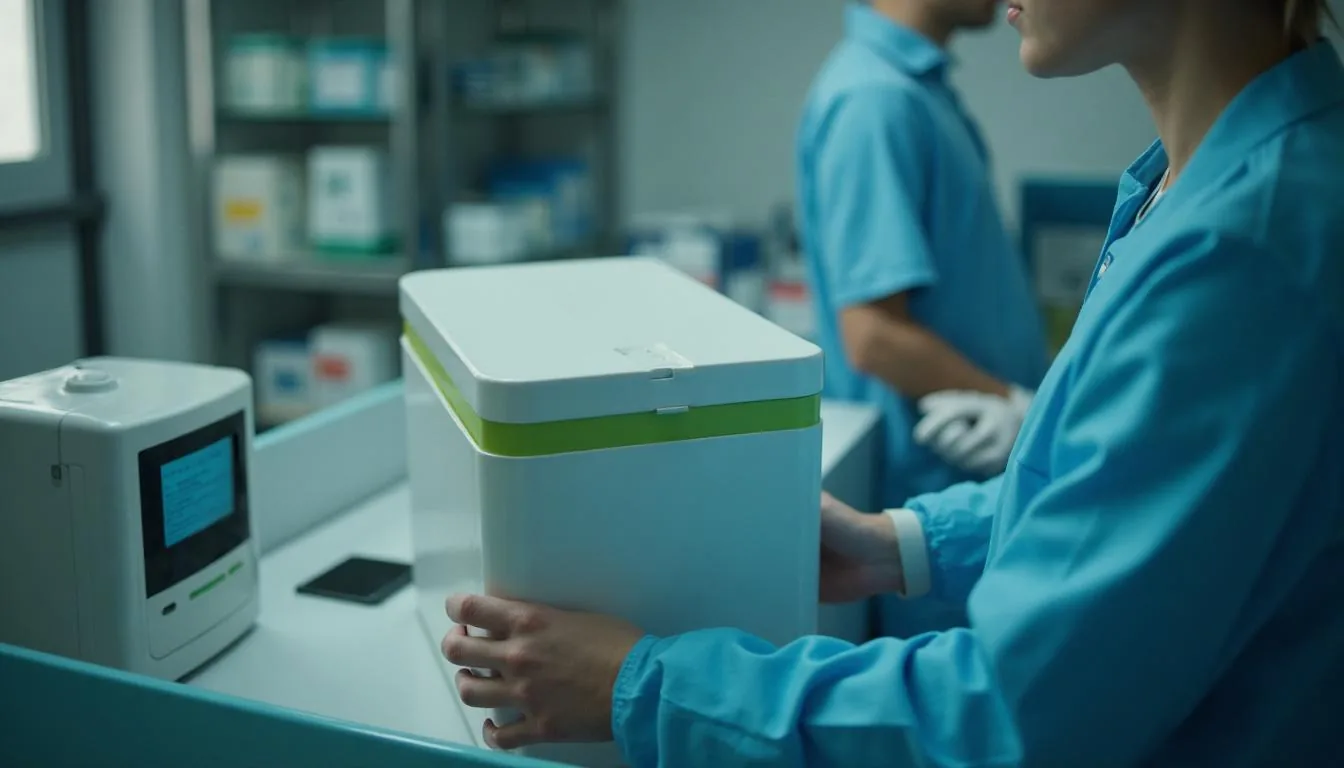
Medical courier software that keeps custody on the specimen from the draw chair to the lab bench
A medical courier is a driver who moves diagnostic specimens, blood products and pharmacy items between draw sites, clinics, hospitals and laboratories under a chain of custody. Most of that freight is a Category B infectious substance, and 49 CFR 173.199 requires triple packaging with absorbent material, an outer surface no smaller than 100 mm by 100 mm, and a package that survives a drop from 1.2 meters without the primary receptacle leaking. Neurobird holds the route, the temperature reading and the custody signature on one manifest.
Neurobird Medical Courier in short
- Build the run from standing stops and drop a STAT pickup into the route that can actually reach it
- Capture custody at the point of transfer, with the time, the container and the person who took it
- Log temperature at pickup and at delivery against the specimen rather than against the shift
- 1.2 meters Drop height a Category B infectious substance package must survive with no leakage from the primary receptacle, and at least one outer surface must measure 100 mm by 100 mm. 49 CFR 173.199
- 95 kPa Internal pressure differential the primary receptacle or secondary packaging must hold without leaking for carriage by aircraft, where no primary receptacle may exceed 1 L and no outer packaging may exceed 4 L. 49 CFR 173.199
- Pricing runs 189 to 1250 US dollars per month across 3 tiers. Early access is free.
What medical courier companies actually deal with
Why it stays broken
Courier work sits between two regulated worlds and belongs to neither. The laboratory owns the specimen record under CLIA, the road owns the package under the hazardous materials regulations, and the driver in the middle gets a clipboard. General delivery software does not know what a Category B infectious substance is, or that a hazmat employee needs recurrent training at least once every three years under 49 CFR 172.704, so the regulated half of the job stays on paper.
Under 49 CFR 172.704 a hazmat employee must be retrained at least once every three years, and the employer must hold a record of current training covering the preceding three years.
Specimens must be ready at scheduled pick-up time and hand delivered to courier representative.
What the rules say about carrying specimens
Federal packaging limits for infectious substances, hazmat training and reporting deadlines, and the laboratory standard that governs the specimen at both ends of the run.
Drop height a Category B infectious substance package must survive with no leakage from the primary receptacle, and at least one outer surface must measure 100 mm by 100 mm.
49 CFR 173.199Internal pressure differential the primary receptacle or secondary packaging must hold without leaking for carriage by aircraft, where no primary receptacle may exceed 1 L and no outer packaging may exceed 4 L.
49 CFR 173.199Recurrent training cycle for every hazmat employee, with initial training due within 90 days of hire or of a change in job function, and the record kept for 90 days after employment ends.
49 CFR 172.704Deadline to submit DOT Form F 5800.1 after discovering a reportable incident, with a copy retained for two years and produced within 24 hours of a request by the Department of Transportation.
49 CFR 171.16Window for telephone notice to the National Response Center after an incident that meets the immediate notice criteria in the hazardous materials regulations.
49 CFR 171.15The bloodborne pathogens standard, which keeps training records for 3 years, requires hepatitis B vaccination to be offered within 10 working days of assignment, and requires a second container when the outside of the primary one is contaminated.
OSHA 29 CFR 1910.1030Neurobird Medical Courier Dispatch Platform
One record per run: the stops in order, what was collected at each, the temperature at every handoff, who signed for it, and the training and packaging evidence standing behind the driver who carried it.
- 1Build the run from standing stops and drop a STAT pickup into the route that can actually reach it
- 2Capture custody at the point of transfer, with the time, the container and the person who took it
- 3Log temperature at pickup and at delivery against the specimen rather than against the shift
- 4Hold each driver's hazmat training record where an auditor can find it in one click
What changes with Neurobird Medical Courier?
The same work, read left to right: how it runs today, and how it runs once the record is in one place.
| Today | With Neurobird Medical Courier |
|---|---|
| A cooler rides three extra stops because the STAT request came in on a phone call nobody wrote down | Build the run from standing stops and drop a STAT pickup into the route that can actually reach it |
| The chain of custody is a clipboard sheet photographed at the end of the shift, if it is photographed at all | Capture custody at the point of transfer, with the time, the container and the person who took it |
| The lab rejects a specimen for temperature and there is no reading to argue with, only a driver's memory | Log temperature at pickup and at delivery against the specimen rather than against the shift |
Who is this for?
The same cooler, three very different operations.
You dispatch from the driver's seat
Standing routes plus whatever the phone brings in. You need the run to reorder itself without a whiteboard and a memory.
You carry for several laboratories
Each client has its own cutoffs, containers and rejection rules. You need the manifest to prove which one was followed.
You move specimens inside one network
Draw sites, pharmacy and the core lab on the same fleet. You need custody and temperature on one record the lab can audit.
The run board, as your dispatcher would work it
Close a stop and watch custody, temperature and the cutoff clock move with the specimen.
Drag a job onto a driver to assign it.
How does Neurobird Medical Courier work?
Plan the run
Standing stops, cutoff times and lab receiving hours build the route, and an on demand pickup slots into the run that can still make the cutoff.
Sign at the transfer
Each handoff records the time, the container, the person and the temperature, so custody is evidence rather than a signature block filled in at the depot.
Close the manifest
The run closes against the lab that received it, and the training and packaging record for that driver sits on the same page as the delivery.
Medical courier software questions, answered
Key terms
- What is a medical courier?
- A medical courier moves diagnostic specimens, blood products and pharmacy items between collection sites and laboratories under a chain of custody. Most of that freight is a Category B infectious substance, which 49 CFR 173.199 requires be triple packaged, with absorbent material between the receptacles and an outer surface at least 100 mm by 100 mm.
- What are the hazmat training rules for courier drivers?
- 49 CFR 172.704 requires initial training within 90 days of hire or of a change in job function, recurrent training at least once every three years, and a record of current training covering the preceding three years. The employer keeps that record for as long as the person is a hazmat employee and for 90 days afterwards.
Does this replace our dispatch or routing system?
No. It sits beside it. Routing decides who drives where. This holds what was carried, at what temperature, who signed for it and which training record stood behind the driver, which is the part that gets reconstructed after a rejection.
How does it handle temperature for cold chain runs?
Temperature is captured against the specimen at pickup and again at delivery, not once per shift. If a lab rejects a sample you can show the reading at each transfer rather than argue from memory.
Can it prove custody without a paper manifest?
Yes. Each transfer records the time, the container, the person and the reading. The manifest is generated from those transfers, so the paper copy and the record cannot drift apart.
Why we are building this
W
e
w
e
n
t
l
o
o
k
i
n
g
f
o
r
w
o
r
k
t
h
a
t
s
t
i
l
l
r
u
n
s
o
n
a
c
l
i
p
b
o
a
r
d
,
a
n
d
s
p
e
c
i
m
e
n
t
r
a
n
s
p
o
r
t
k
e
p
t
c
o
m
i
n
g
u
p
.
T
h
e
b
o
x
i
s
f
e
d
e
r
a
l
l
y
r
e
g
u
l
a
t
e
d
,
t
h
e
s
p
e
c
i
m
e
n
i
s
f
e
d
e
r
a
l
l
y
r
e
g
u
l
a
t
e
d
,
a
n
d
t
h
e
n
i
n
e
t
y
m
i
n
u
t
e
s
i
n
b
e
t
w
e
e
n
i
s
a
d
r
i
v
e
r
w
i
t
h
a
p
e
n
.
T
h
a
t
i
s
a
r
e
c
o
r
d
p
r
o
b
l
e
m
,
a
n
d
r
e
c
o
r
d
p
r
o
b
l
e
m
s
a
r
e
w
h
a
t
w
e
b
u
i
l
d
.
T
h
e
p
a
c
k
a
g
i
n
g
r
u
l
e
s
a
n
d
t
r
a
i
n
i
n
g
d
e
a
d
l
i
n
e
s
w
e
r
e
a
d
w
h
i
l
e
s
c
o
p
i
n
g
t
h
i
s
a
r
e
l
i
n
k
e
d
a
b
o
v
e
,
s
o
y
o
u
c
a
n
c
h
e
c
k
o
u
r
r
e
a
d
i
n
g
o
f
t
h
e
m
i
n
s
t
e
a
d
o
f
t
a
k
i
n
g
o
u
r
w
o
r
d
f
o
r
i
t
.
I
f
w
e
h
a
v
e
t
h
e
r
u
n
w
r
o
n
g
,
t
e
l
l
u
s
a
n
d
w
e
w
i
l
l
f
i
x
i
t
.
Where the requirement comes from
Primary sources, straight from the regulators.
- 49 CFR 173.199, Category B infectious substances Triple packaging, absorbent material, drop height and the volume limits that apply once a box flies.
- 49 CFR 172.704, hazmat training requirements Initial, recurrent and security awareness training, and exactly what the training record must contain.
- 49 CFR 171.16, hazardous materials incident reports The 30 day filing deadline, the two year retention rule and what triggers an update to a filed report.
- 49 CFR 171.15, immediate notice of certain hazardous materials incidents The 12 hour telephone notice and the incident types that demand it before any paperwork.
- OSHA 29 CFR 1910.1030, bloodborne pathogens Labelling, secondary containment, training records and the sharps injury log a courier fleet inherits.
- 42 CFR 493.1242, specimen submission, handling and referral The CLIA standard behind the receiving end: written transport conditions, and the date and time of receipt.
How much does Neurobird Medical Courier cost?
Priced per operation because the cutoffs, the containers and the training register belong to the company, not to the driver. Stops, specimens and temperature readings are unlimited on every tier.
- Up to 3 drivers
- Unlimited stops
- Chain of custody capture
- Temperature at each transfer
- Unlimited drivers
- Client specific cutoffs
- Hazmat training register
- STAT dispatch board
- Multiple depots
- Lab receiving portal
- Incident report pack
- Priority support
Get free early access
Early access means we model your standing routes, your client cutoffs and your custody sheet before you type anything, and the account stays free while we do it.
Straight answer on where this is: The software is in development. Nothing is purchasable today. Early access means you shape it and pay nothing while we build.
Prefer email? Write to office@neurobird.com and a person will reply. No autoresponder.