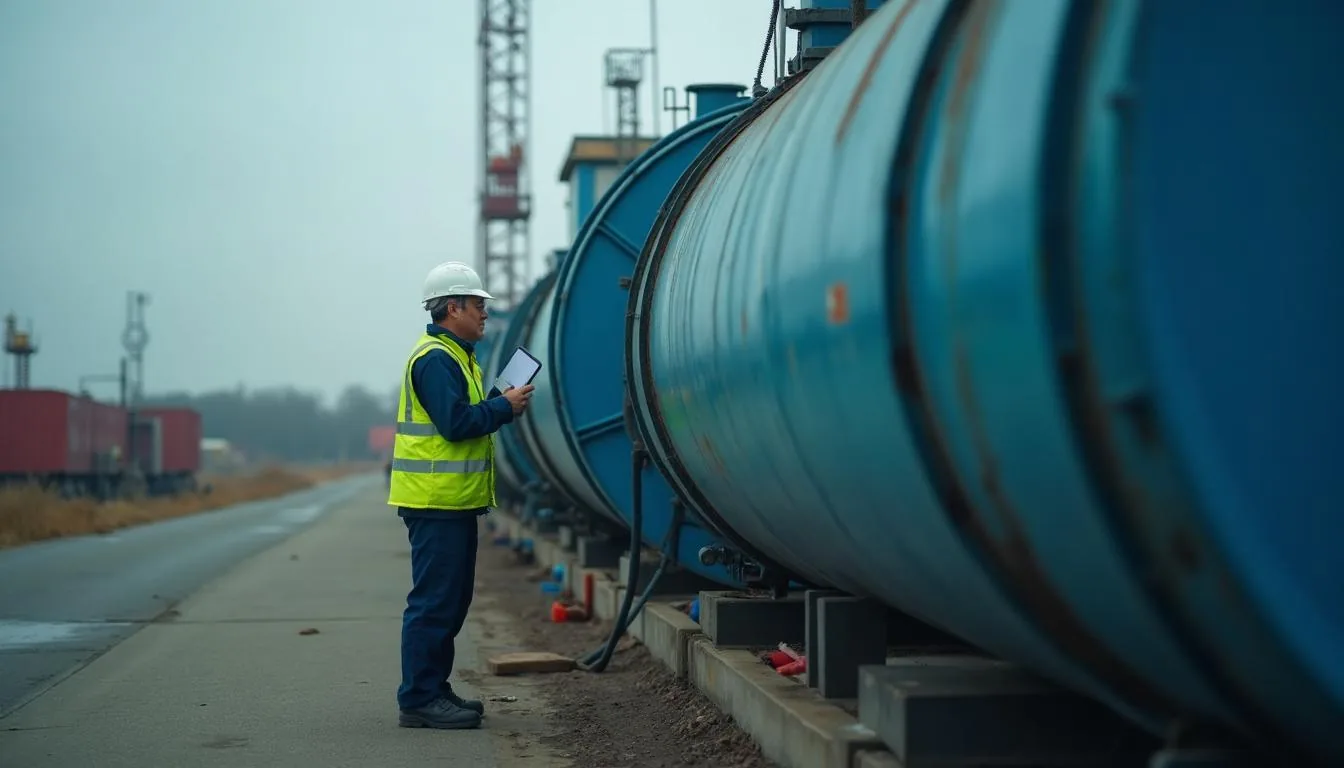
Aboveground storage tank inspection records that a regulator can actually read
Aboveground storage tank inspection is the scheduled examination of bulk oil and chemical containers for integrity, corrosion, leaks, containment and overfill protection, recorded so a regulator can follow it. Under the federal SPCC rule at 40 CFR 112, a facility with more than 1,320 gallons of aggregate aboveground oil storage capacity needs a plan, bulk containers need regular integrity testing, and records are kept for 3 years. Neurobird holds the schedule, the findings and the closeouts together.
Neurobird Aboveground Storage Tank Inspection in short
- Build the inspection schedule from the SPCC plan intervals rather than from memory
- Record monthly visual inspections with photos attached to the specific container, not the site
- Track integrity testing due dates by tank, method and last test date across the whole yard
- 1,320 Aggregate aboveground oil storage capacity in US gallons above which the federal SPCC rule applies to a facility. EPA, oil spill prevention regulations
- 40 CFR 112 The rule itself, covering plan requirements, containment, inspection, integrity testing and recordkeeping for bulk containers. eCFR, Title 40 Part 112
- Pricing runs 110 to 460 US dollars per month across 3 tiers. Early access is free.
What facilities with bulk oil storage and the firms that inspect them actually deal with
Why it stays broken
The SPCC plan is a PDF written by an engineer, and the inspection programme it specifies is executed on paper by people who were not there when it was written. The 2 things drift apart within about 18 months.
A facility with 38 containers on 4 different inspection intervals is running roughly 500 inspection events a year.
If you are the owner or operator of a qualified facility with aboveground oil storage containers, you must inspect these containers for integrity on a regular basis in accordance with industry standards.
Neurobird Aboveground Storage Tank Inspection Compliance Platform
Turn the plan into a schedule. Each container carries its own intervals, its own history and its own open findings, so the programme survives the person who wrote it.
- 1Build the inspection schedule from the SPCC plan intervals rather than from memory
- 2Record monthly visual inspections with photos attached to the specific container, not the site
- 3Track integrity testing due dates by tank, method and last test date across the whole yard
- 4Close findings with dated corrective actions so an inspector can read the loop rather than reconstruct it
What changes with Neurobird Aboveground Storage Tank Inspection?
The same work, read left to right: how it runs today, and how it runs once the record is in one place.
| Today | With Neurobird Aboveground Storage Tank Inspection |
|---|---|
| The SPCC plan lists inspection intervals for 38 containers, and the actual records are in 3 binders and a phone camera roll | Build the inspection schedule from the SPCC plan intervals rather than from memory |
| A finding gets written up, the repair happens, and nothing ties the closeout back to the original inspection | Record monthly visual inspections with photos attached to the specific container, not the site |
| The inspector who knows the site is retiring, and the schedule for the next 5 years exists only in his head | Track integrity testing due dates by tank, method and last test date across the whole yard |
Who is this for?
Same tanks, three different obligations.
You own the tanks
You carry the plan and the liability. You need the schedule to run without depending on one long serving person.
You cover many yards
Every site does it slightly differently. You need one register and a view of what is overdue across all of them.
You inspect for clients
Your product is the record. You need findings, photos and closeouts in a format the client can hand to a regulator.
The yard, as your inspector would walk it
A working preview. Tick a container to log its inspection.
| Requirement | Status | Next due | |
|---|---|---|---|
| Tank 12, water bottom drained | current | in 42d | |
| Secondary containment, 110 percent check | due soon | in 9d | |
| Overfill alarm test, failed | current | in 120d | |
| Shell integrity test due, 5 year interval | overdue | 3d late | |
| Tank 7, 12,000 gallon diesel, monthly visual | current | in 64d |
Tick a requirement to file evidence against it.
How does Neurobird Aboveground Storage Tank Inspection work?
Load the containers and intervals
Every bulk container gets a record with capacity, service, containment and the inspection intervals its plan specifies.
Inspect against the container
Monthly visuals, containment checks and integrity tests are logged to the specific tank with photos, dates and the inspector attached.
Close the loop on findings
Every finding carries a corrective action with an owner and a date, so the file shows the loop closed rather than the problem noticed.
What the SPCC rule actually requires
Useful if you are writing or auditing a plan. Each source links out.
Aggregate aboveground oil storage capacity in US gallons above which the federal SPCC rule applies to a facility.
EPA, oil spill prevention regulationsThe rule itself, covering plan requirements, containment, inspection, integrity testing and recordkeeping for bulk containers.
eCFR, Title 40 Part 112Aggregate gallon ceiling for a Tier I qualified facility, alongside no single container above 5,000 gallons, which decides how much plan you actually need.
EPA, tank inspection guidance for Tier I facilitiesMinimum retention for SPCC inspection and testing records, kept with the plan and produced on request.
EPA, SPCC guidance for regional inspectorsThe OSHA flammable liquids standard, which governs tank construction, spacing and venting alongside the environmental rules.
OSHA, 29 CFR 1910.106Aboveground storage tank inspection software questions, answered
Key terms
- What is aboveground storage tank inspection?
- Aboveground storage tank inspection is the scheduled examination of bulk oil and chemical containers for integrity, leaks, corrosion, containment condition and overfill protection, recorded so a regulator can read it. Under the federal SPCC rule, the intervals come from the facility's own plan and the records are the proof it was followed.
- What is a Tier I qualified facility?
- A smaller facility that can self certify a simplified plan: aggregate aboveground oil storage of 10,000 US gallons or less, no single container above 5,000 gallons, and a clean discharge history. It still needs inspections and records, just a shorter plan template.
Which facilities are actually covered?
The SPCC rule at 40 CFR 112 applies to facilities with an aggregate aboveground oil storage capacity above 1,320 US gallons that could reasonably discharge oil to navigable waters. Underground storage sits under a separate programme, so many sites carry obligations under both.
How long do inspection records have to be kept?
SPCC inspection and testing records must be kept with the plan for 3 years. In practice that is the minimum, because a corrosion argument or a discharge investigation will reach back further than the retention rule does.
Does this replace an API 653 certified inspection?
No. Formal integrity inspections are done by qualified personnel to the applicable standard. This tracks when each one is due, what it found, and whether the corrective actions were actually closed out.
Why we are building this
Tank inspection is a scheduling problem dressed as an environmental one. The rules are clear, the intervals are known, and the failure mode is almost always that nobody generated the schedule from the plan.
Then a finding is written up, fixed, and never closed out on paper, so the file shows a problem observed and no evidence of a repair.
We would rather build this with the people who walk the yard. Tell us how your programme runs, and where we have got it wrong.
Where the requirement comes from
The federal rule and the guidance that inspectors work from.
- EPA, oil spill prevention regulations The SPCC programme overview: who is covered, what a plan must contain and how it is certified.
- eCFR, 40 CFR Part 112 The regulation itself, including bulk container integrity testing and recordkeeping requirements.
- EPA, tank inspection guidance for Tier I facilities Practical inspection guidance for smaller qualified facilities that self certify their plan.
- OSHA, 29 CFR 1910.106 flammable liquids Tank construction, spacing, venting and storage requirements that sit alongside the environmental rules.
How much does Neurobird Aboveground Storage Tank Inspection cost?
Priced per facility because the plan is a facility level document. Containers, inspectors and photos are unlimited.
- Container register
- Interval based scheduling
- Photo attached inspections
- Finding log
- Email support
- Everything in Single site
- Corrective action closeout
- Integrity test due dates
- Inspector ready export
- Named contact
- Everything in Multi site
- Plan version control
- Third party inspection firm access
- Overdue escalation
- Onboarding included
Get free early access
If you inspect or own tanks, tell us how the schedule is kept and where the records actually live.
Straight answer on where this is: In development. Early access gets the working preview, a say in what ships first, and early access pricing. It does not get you a login today.
Prefer email? Write to office@neurobird.com and a person will reply. No autoresponder.