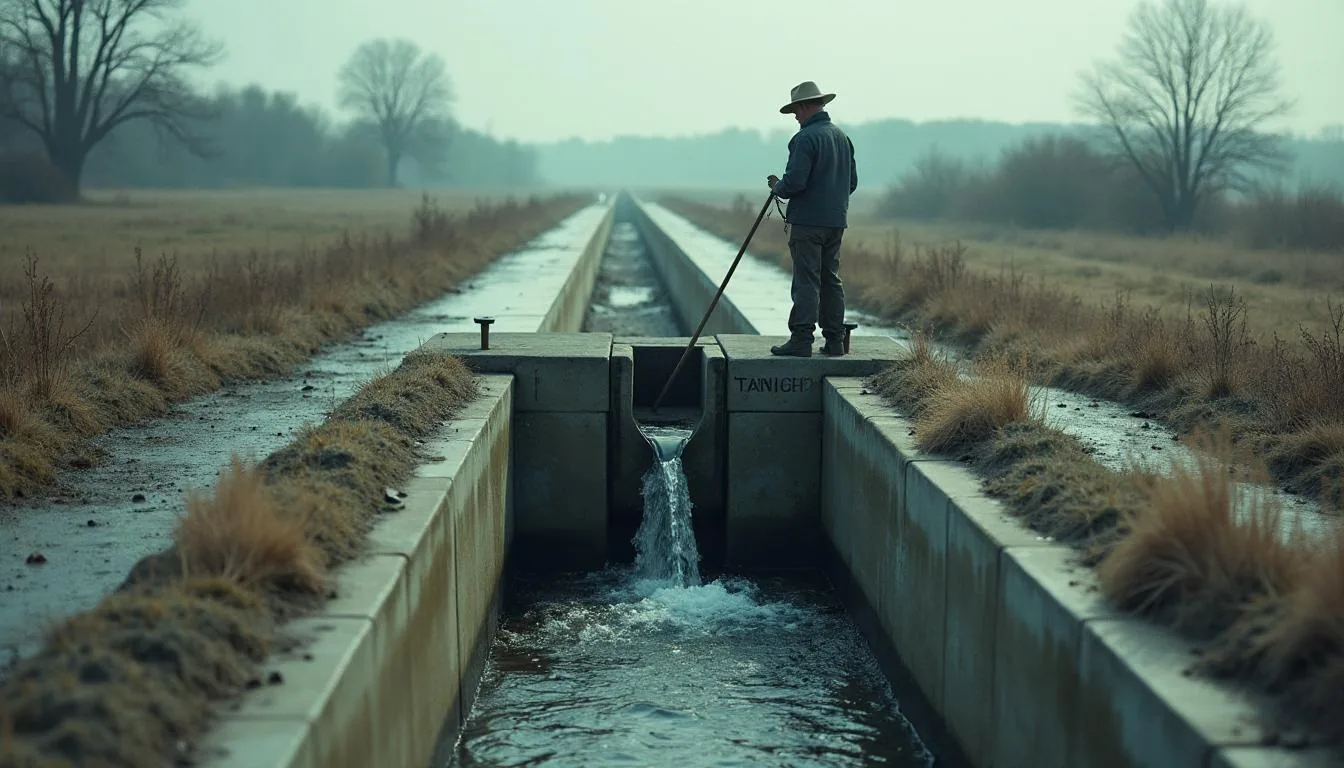
Irrigation district software that ties the water order to the delivery and the bill
An irrigation district is a local public entity that delivers water from a river, reservoir or well field to farms through canals, laterals and turnouts, and funds itself by assessing landowners. Irrigation accounts for roughly 42 percent of US freshwater withdrawals, about 118 billion gallons a day, across roughly 55 million irrigated acres. Neurobird keeps the order, the gate setting, the measured delivery and the assessment on one parcel record.
Neurobird Irrigation District Water in short
- Take water orders against the parcel and its entitlement rather than against a name on a notepad
- Give ditch riders a run list with gate settings and expected duration for each turnout
- Convert measured flow to acre feet delivered and post it to the parcel automatically
- 118B Approximate gallons per day withdrawn for irrigation in the United States, the largest category of freshwater withdrawal after thermoelectric power. USGS, water use in the United States
- 42% Approximate share of US freshwater withdrawals that goes to irrigation, which is why district level accounting attracts scrutiny. USGS, water use in the United States
- Pricing runs 220 to 900 US dollars per month across 3 tiers. Early access is free.
What irrigation and water districts actually deal with
Why it stays broken
Districts are small public bodies running a utility with a staff of 8 and a season of 200 days. Utility billing software does not understand acre feet, and farm software does not understand a canal.
One acre foot is about 325,851 gallons, so a rounding habit at the gate becomes a real number on the assessment.
Reclaimed wastewater is a supplemental source of water for thermoelectric power, especially in water-limited areas.
How does Neurobird Irrigation District Water work?
Take the order against the parcel
Orders record who asked, for how much, from which turnout, and are checked against the parcel's remaining entitlement before the gate moves.
Give the rider a run list
Each ditch rider gets turnouts, gate settings and expected durations for the day, and logs actual settings and times against them.
Reconcile delivery to assessment
Measured flow converts to acre feet on the parcel record, so the assessment comes off measured deliveries rather than a season end estimate.
Neurobird Irrigation District Water Audit Platform
Put the parcel at the centre. Entitlement, orders, deliveries and assessments all attach to it, so an allocation change is a recalculation rather than a rewrite.
- 1Take water orders against the parcel and its entitlement rather than against a name on a notepad
- 2Give ditch riders a run list with gate settings and expected duration for each turnout
- 3Convert measured flow to acre feet delivered and post it to the parcel automatically
- 4Recalculate entitlements when allocation changes without redoing the whole ledger by hand
What changes with Neurobird Irrigation District Water?
The same work, read left to right: how it runs today, and how it runs once the record is in one place.
| Today | With Neurobird Irrigation District Water |
|---|---|
| Water orders come in by phone and text, get written on a ditch rider's notepad, and reappear as a delivery figure 3 days later | Take water orders against the parcel and its entitlement rather than against a name on a notepad |
| Deliveries are measured in cfs at the gate and billed in acre feet on the parcel, and the conversion happens in somebody's head | Give ditch riders a run list with gate settings and expected duration for each turnout |
| When the allocation is cut to 65 percent mid season, every parcel's entitlement has to be recalculated on paper | Convert measured flow to acre feet delivered and post it to the parcel automatically |
Who is this for?
Same canal, three different jobs.
You have a staff of 8
The manager takes orders and the riders run the ditches. You need the paper trail without adding a person.
You deliver to thousands of acres
Several laterals, several riders, one allocation. You need deliveries reconciled daily rather than at season end.
You bill by share
Entitlement is share based rather than acreage based. You need billing that follows the shares without a custom spreadsheet.
What irrigation water accounting actually involves
Useful if you manage a district or are writing a water accounting policy. Each source links out.
Approximate gallons per day withdrawn for irrigation in the United States, the largest category of freshwater withdrawal after thermoelectric power.
USGS, water use in the United StatesApproximate share of US freshwater withdrawals that goes to irrigation, which is why district level accounting attracts scrutiny.
USGS, water use in the United StatesThe most recent federal Irrigation and Water Management Survey, covering irrigated acreage, water sources, systems and costs at farm level.
USDA NASS, Irrigation and Water Management SurveyAcreage limit for federally supplied irrigation water held or leased by a qualified recipient under the Reclamation Reform Act, with reporting attached.
eCFR, 43 CFR Part 426A dedicated federal survey of irrigation organizations exists precisely because districts, ditch companies and associations are a distinct sector with their own accounting.
USDA NASS, irrigation organizationsThe lateral, as your ditch rider would run it
A working preview. Tick a turnout to record its delivery.
Tap an asset to log a scan and timestamp the inspection.
Irrigation district water software questions, answered
Key terms
- What is an irrigation district?
- An irrigation district is a local public entity that delivers water from a river, reservoir or well field to farms through canals, laterals and turnouts, and funds itself by assessing landowners. It is a utility, a public body and a water rights holder at the same time, which is why its record keeping obligations are heavier than they look.
How is delivered water actually measured and billed?
Flow is measured at the turnout in cubic feet per second, and billing is usually per acre or per acre foot delivered. One acre foot is roughly 325,851 gallons, so a small conversion error at the gate becomes a large billing error on the parcel.
What happens when allocation is cut?
Entitlements are recalculated as a percentage of the full allocation, and every parcel's remaining water changes at once. Districts that hold entitlements in a spreadsheet redo that calculation by hand, mid season, while the phone is ringing.
Does federal law affect how much water a landowner can take?
On federal projects, yes. The Reclamation Reform Act limits federally supplied irrigation water to 960 acres held or leased by a qualified recipient, with reporting obligations attached, so acreage records are a compliance artefact and not just a billing input.
Does this replace our SCADA or gate telemetry?
No. It reads from it where it exists. The order, the run list, the measured delivery and the assessment live here, and whatever hardware you have at the gate keeps doing its job.
Why we are building this
An irrigation district is a utility that bills in acre feet, delivers through open channel, and answers to landowners who can see the ditch from their kitchen window. Nothing off the shelf fits that.
So the order lives on a notepad, the delivery lives in a rider's memory, and the assessment is assembled in the fall from both.
We would rather build this with district managers and ditch riders. Tell us how your season actually runs, and where we have got it wrong.
Where the requirement comes from
Federal sources on water use, irrigated acreage and reclamation law.
- USGS, water use in the United States National water withdrawal estimates by category, including irrigation, at state and county level.
- USDA NASS, Irrigation and Water Management Survey Farm level data on irrigated acreage, water sources, systems, energy and cost.
- USDA NASS, irrigation organizations survey The federal survey covering districts, ditch companies and other irrigation organizations as a sector.
- eCFR, 43 CFR Part 426 Acreage limitation and water conservation rules for federally supplied irrigation water.
How much does Neurobird Irrigation District Water cost?
Priced per district because that is the operating unit. Parcels, turnouts, riders and orders are unlimited.
- Parcel and entitlement records
- Water order intake
- Ditch rider run lists
- Delivery logging
- Email support
- Everything in Small district
- Acre foot reconciliation
- Assessment billing
- Allocation recalculation
- Named contact
- Everything in District
- Telemetry and SCADA import
- Multi source accounting
- Reporting for state and federal filings
- Onboarding included
Get free early access
If you run a district, tell us how orders arrive and how deliveries turn into assessments today.
Straight answer on where this is: In development. Early access gets the working preview, influence on what ships first, and early access pricing. It does not get you a login today.
Prefer email? Write to office@neurobird.com and a person will reply. No autoresponder.